
Trace White County Former Owners Backward
Build the list of White County former owners from the newest deed toward the oldest. One supported link at a time. Pull the parcel ID and legal description from the current assessment card, then locate the latest conveyance in the GSCCAA deed index. The grantor on that instrument is your next earlier lead. A repeated surname or street address proves nothing. The legal description must keep pointing to the same White County land in deed after deed.
| Source | Years It Covers | Where Held | What It Shows |
|---|---|---|---|
| GSCCCA real-estate index | Verify live White coverage | Online statewide portal | Parties, instrument type, dates, book/page and images where available |
| Superior Court deed books | Series-dependent | White County Clerk | Earlier conveyances and legal descriptions |
| Plat books | Series-dependent | Clerk and archival copies | Subdivision, lot, road and easement history |
| Tax digests | 2016-2026 online; older on microfilm | County site and Georgia Archives | Annual owner, value and tax context |
Start online for a recent chain. The Clerk of Court holds images and older book references the portal lacks. Use annual digests to narrow a transition year. A digest never replaces the deed itself. For older work, Georgia Archives county cards, microfilm, and FamilySearch catalogs identify surviving series, while the live portal and the Clerk control the question of White County's earliest online deed year.
Go Back Through Grantor and Grantee Roles
Every conveyance has two roles. The grantee receives the stated interest; the grantor conveys it. To move backward, read the grantor on the current deed, then hunt for the earlier instrument where that same party or entity appeared as grantee. Copy initials, suffixes, punctuation, trustee capacity, and estate language exactly as recorded. Run the variants anyway. Indexes often split a married name or an old entity spelling across separate entries.
The GSCCCA name search filters by party type, instrument type, county, name, and date, so select White County and narrow only after learning the party's recorded form. Check the official party controls before building the chain.
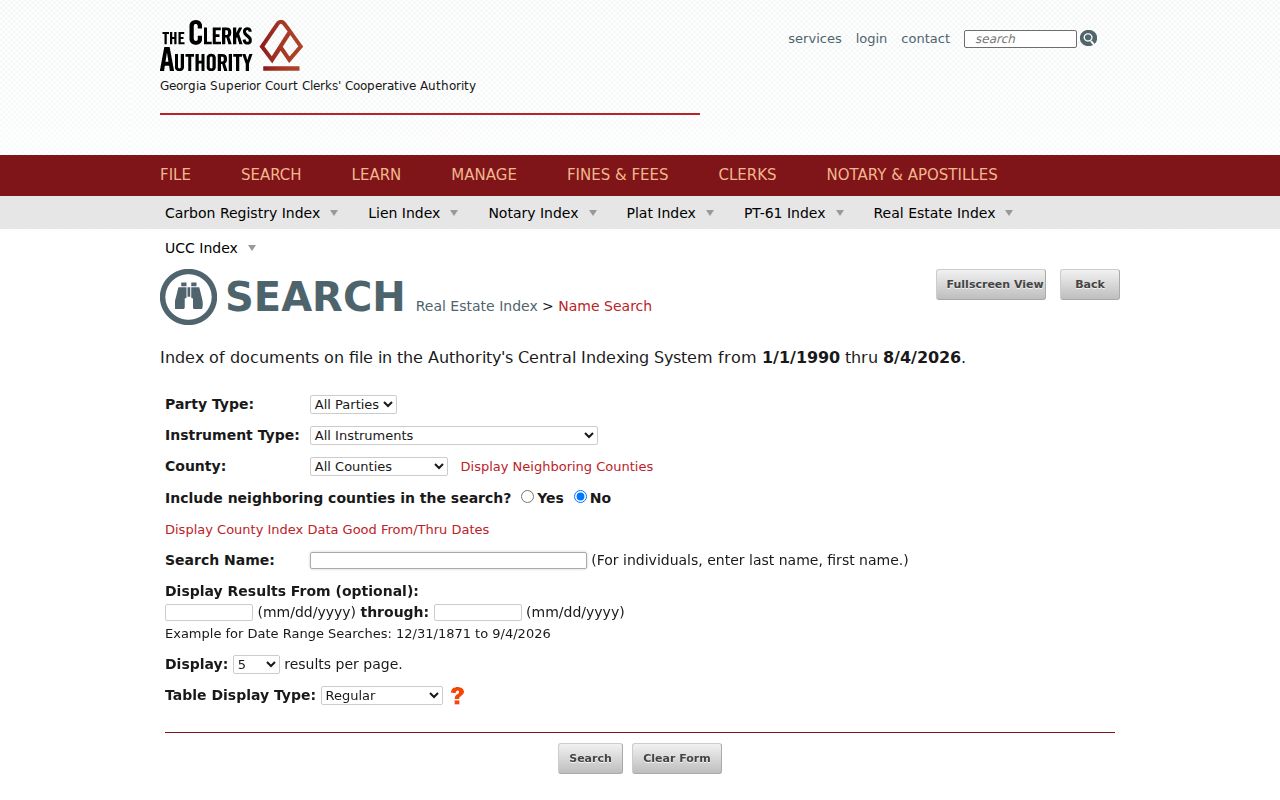
Filters only find candidates. The image and the legal description decide membership. Label security deeds, releases, assignments, liens, and corrections carefully, because not every indexed land instrument in White County transfers ownership.
Reconstruct Splits and Correction Deeds
Today's parcel outline may not match its parent tract. Compare acreage, land lot, district, subdivision, lot, road, monuments, and adjoining owners at every step. A correction deed can repair a name or a description. It does not create a new sale. A recorded plat can divide a parent tract into child parcels whose new assessment identifiers never appear in the older deed.
When the chain branches, split it. Give each child tract its own line. Cite the recorded plat. White County Planning approves plats in its jurisdiction, the Clerk records them, and Cleveland may require city approval first, while approval files explain development history but never substitute for recorded instruments and matching descriptions.
Keep Annexation Outside the Deed Timeline
Municipal borders move. Ownership often stays put. The July 2025 agreement between Helen and White County corrected county-map omissions. The omissions involved parcels annexed in 1997 and 2022. A deed recorded before annexation belongs with county context. A present zoning file belongs with Helen. Note the shift beside your chronology, never as a transfer.
Date the municipal map you use. For land near Cleveland or Helen, postal labels like Sautee Nacoochee or Robertstown are search clues only. They are not proof of incorporation. White County's official roster lists just two incorporated municipalities, Cleveland and Helen.
Walk the White County Deed Chain Backward
Keep a working table. Give every instrument its own row. Record the instrument or book and page number, execution and recording dates, grantor, grantee, deed type, consideration if shown, legal description, prior-deed reference, source link, and any unresolved mismatch.
- Find the newest conveyance for the current parcel and verify its legal description.
- Read the conveying grantor and any prior-deed citation.
- Search that party as an earlier grantee, then compare dates and tract descriptions.
- Continue through Clerk books, microfilm, and archives when the online chain stops.
- Grantor / grantee
- The conveying and receiving parties for the stated interest.
- Chain of title
- The linked sequence of recorded conveyances for the same land.
- Legal description
- The land identity that survives address and parcel-number changes.
Use White County Digests as Annual Clues
The Tax Digest and 5-Year History page posts White County files from 2016 through 2026. Each digest shows ownership, values, and a tax year. A name change between files marks a window. Search the recorded deeds in that interval for the actual execution and recording dates.
A value or exemption change is not a conveyance. A tax roll can lag a freshly recorded deed too. Preserve the digest year and the file itself. That way a yearly clue never masquerades as recorded proof. When the county's posted files end, older digests at Georgia Archives extend the same method.
Digests also preserve spellings and tract labels. Copy a variant as a search lead. Then verify it in the deed index independently. A tax lien or Fi.Fa. is not an ownership transfer either. White County notes a seven-year Clerk recording period for certain tax liens. It also notes a one-year redemption period after a tax sale. A levy, advertisement, sale, redemption, and eventual deed are distinct events. Each needs its own date.
Continue Through Estates and Historic Books
A name chain sometimes drops an owner. The title may have passed through an estate, a court order, a trustee's transaction, or an entity styled differently from the family name. Hunt for a recorded executor's, administrator's, or trustee's deed. Use probate material only to establish the authority behind the transfer. The FamilySearch White County probate catalog covers 1858 through 1948 records. A beneficiary list alone proves no transfer.
Microfilm widens the trail. The Georgia Archives county-record collection includes deed, tax, and probate microfilm. Cite repository, series, reel, item, image, book, and page. White County Historical Society staffs a courthouse research room. Its volunteers can interpret old place names that no longer appear on maps. The courthouse dates from 1859 to 1862, yet historical color never substitutes for title evidence.
Run entity and fiduciary names both ways. Search each as grantor and as grantee. Use only name variants a source supports. A trustee may appear under the trust name in one instrument and a capacity abbreviation in another. An executor's deed can be indexed under the estate, the decedent, the fiduciary, the buyer, or several of those parties. Record each query and each dead end. A reproducible chain beats one only you can follow.
Do not overlook a prior-deed citation inside the instrument image itself. Index results are finding aids, while the deed can name the earlier book and page directly. It may also reveal a reservation, easement, partial interest, or tract exception that changes what must be followed backward. Abstract those details without interpreting their legal effect.
Extend White County Ownership Records Offline
Not every deed lives online. When GSCCCA lacks an image or an earlier deed, request it from the White County Clerk Recording Division, which fills copy orders in person or by mail. Supply a book and page or a party name with an approximate date, pay in advance, and include a self-addressed stamped envelope for mail. GSCCCA eCert also issues electronic regular and certified copies. The county's general Open Records form excludes Clerk real-estate records. Send this request straight to the Clerk.
Set confirmed conveyances beside the rest. Plats, permits, assessment rolls, and municipal maps stay separate. The county Archive Center holds dated agendas, ordinances, boundary maps, and planning files. Preserve each document title, date, URL, and PDF page. Label a planning application proposed or under review unless a later source proves approval, recording, and construction.
Some situations call for a professional title examiner. A purchase, an unresolved estate, a missing link, or a boundary dispute all qualify. A personal timeline cannot clear a lien, interpret an ambiguous reservation, or establish marketable title, so flag gaps openly rather than bridging one with a family hunch. Guesswork is not a link.
Lawful use. Research White County former owners for property history, estate work, purchase diligence, and title questions. Do not use a historic chain or current contact detail to monitor, threaten, harass, or harm anyone.